Football / Opinion
Georgia Tech isn’t a victim of college football’s new economy
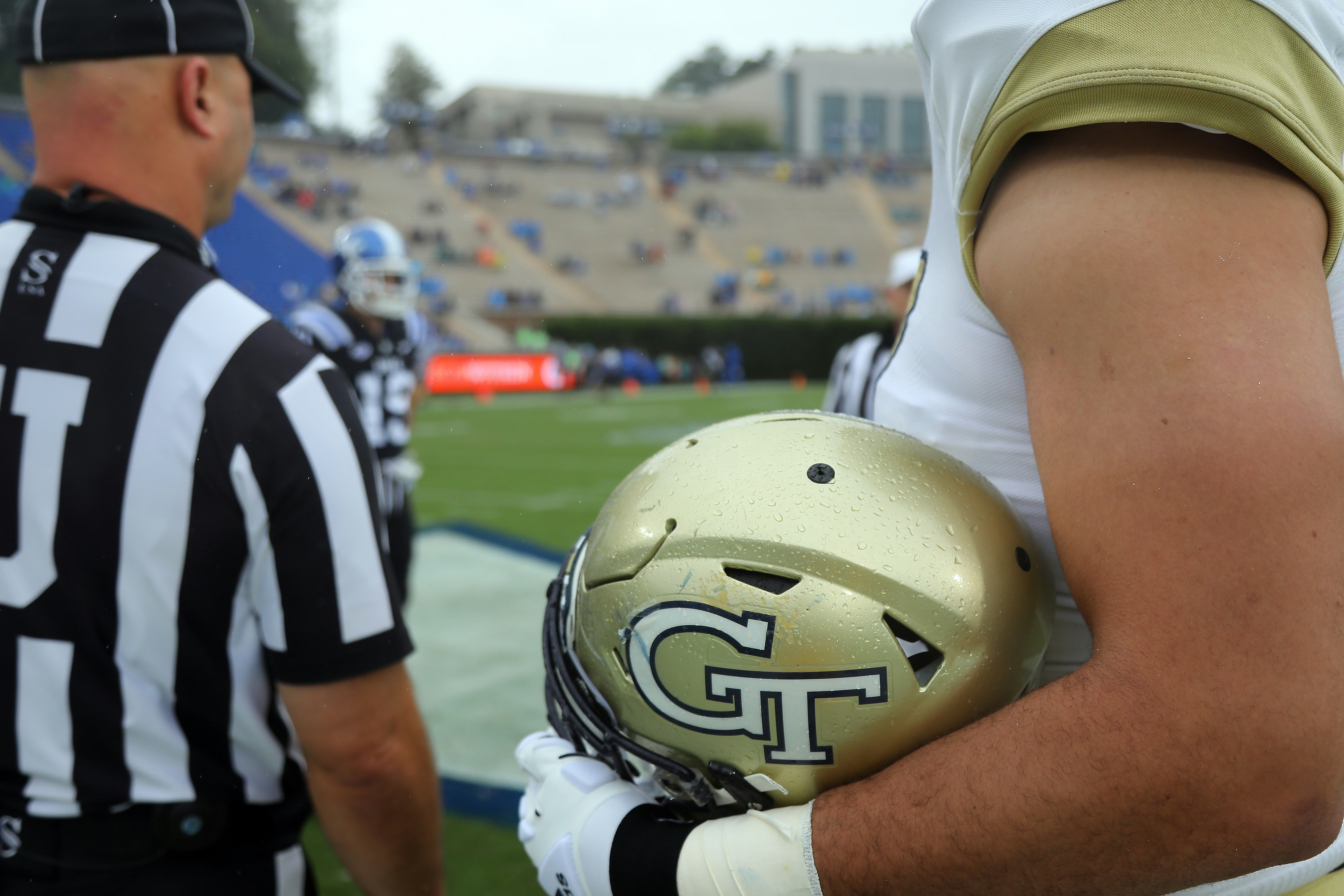
“We will never sniff a Natty,” StingTalk user MACHETE announced after Tech’s loss to the Tennessee Volunteers in September that left the Jackets 0-2. The user then encouraged fellow fans to recalibrate their expectations about the program, claiming the program’s limited finances, smaller alumni base and the attention economy of the Atlanta metropolitan area imposed a structural ceiling on the program’s potential.
By late October, a different perspective was being shared on X by user T. McClure, with Tech at 2-5: “Too much money involved now to not acknowledge and make adjustments.”
This may seem like a change in sentiment from fans, but both opinions had always been present in the fanbase. In MACHETE’s StingTalk thread, a user named Buzzilla recognized the economic realities of Georgia Tech but argued that the program can recover financially and that economic strength does not guarantee success. “Money won't mean an automatic level up, but it will certainly mean you can weather the storms and course correct much more easily. But even that has its limits. Looking at you FSU.”
So who’s right? Are the Yellow Jackets structurally disadvantaged or failing to use the resources they have access to?
The modern landscape of college football hasn’t priced Georgia Tech out. Tech finished 9-4 in 2025 while spending below the ACC median and carrying heavy facilities debt. That team showed what the Jackets’ means could do in the ACC. This season’s collapse is a failure to convert those resources, not proof that Tech is uniquely disadvantaged in the NIL era.
Tech’s revenue was a record $175 million in fiscal 2026, up 12% from $156 million. It’s not all football money, though: the $110 million fundraising figure includes commitments, and concerts boosted the total.
The debt the Yellow Jackets carry puts a qualifier on the good news the numbers imply. The athletic association carried about $296 million in long-term obligations at the end of fiscal 2025, much of it facilities debt that has been refinanced multiple times since the turn of the century. About $15 million a year goes to principal and interest. That’s about three-quarters of the $20.5 million it budgeted to pay athletes. One bond, which still costs more than 5%, paid to unwind a bad interest-rate gamble from the mid-2000s. That’s not all: up to $70 million in stadium financing has received preliminary approval, continuing the pattern of borrowing for facilities. Tech paying off debts hasn’t made it poor, but it slightly hamstrings its financial muscle. Although Tech’s debt is about 3.5 times the median among ACC public schools, it isn’t the heaviest in the ACC: Florida State reported about $437 million in athletics debt in fiscal 2025.
The ceiling argument isn’t without merit, though. The ACC’s 14 full-share football members averaged about $47 million in distributions in 2024–25, compared with the Big Ten’s roughly $80 million and the SEC’s $72 million for full-share members. Tech has a ceiling nationally, but so does almost every ACC school.
That brings us to something more consequential for Tech than for many schools: the transfer portal and the opportunities that come with it, although a program must remain vigilant to maintain continuity and culture when using it.
Transfers still have to meet Tech’s academic and credit transferability requirements. That has always been a limitation of the Yellow Jackets but doesn’t obliterate the available player pool. Whether that limit survives the sport’s professionalization remains to be seen.
Coach Brent Key has spoken in detail about the transfer portal’s central role in roster building, particularly in an August Atlanta Journal-Constitution article, where he called it an inexact science and was frank about the risk: “And you put it all together,” Key said, “and then you cross your fingers and hope like hell that you get it right.”
The rankings suggest he has reason for that hope: the 2026 class ranked No. 28 nationally and No. 6 in the ACC in the 247Sports composite. That transfer class had 19 arrivals, including Alberto Mendoza from Indiana and Justice Haynes from Michigan.
A tempting parallel to draw is Indiana’s 2025 title, which came after Indiana took 52 transfers in two years. The portal is enticing to describe as an equalizer in the modern game, but much of that comes with the qualifier of Indiana’s access to Big Ten money as well as coach Curt Cignetti’s own system and familiarity with players from JMU he brought with him.
This season’s results are emblematic of the danger of this approach. They show the downside of relying on transfers as a strategy, as well as Tech’s failure to convert its resources into success. For all the talent the transfer class added, the players did not click with each other. Coach Key was also blunt about this: “I feel like at times we have 11 independent contractors on the field at all times,” he said in a September interview with the AJC. While that may be what a modern college football player largely is, professionalism needn’t remove team spirit. Its absence reflects a failure of roster management, and it shows in the results on the field this year. No amount of injuries, which Key cited in the article, excuses a failure like that, and the injuries also suggest issues in accounting for depth during roster construction.
That is a bigger issue for Tech’s future than whether it can compete in the current structure of college football. Programs like this live by the portal and die by the portal. The most famous example is conference-mate Florida State, which went 13-0 in the 2023 regular season and 10-22 in the years since, losing most of its top players and staff. Tech’s 2026 was similar, with a reshuffled line, new coordinators and a new quarterback. Continuity is a big problem for programs like these.
This article won’t become a referendum on whether Key deserves a mulligan, but it’s worth noting that Mike Norvell was fired Nov. 1 with portal misses and misread quarterback market listed among causes. The chaos of the modern sport would have been as good an excuse as any, and Florida State also spent the fourth-most of any ACC athletic department.
Perhaps MACHETE was right about coming to terms with what Tech football is, but that means accepting that the Yellow Jackets won’t outspend Michigan. It doesn’t mean accepting Tech as a P4 bottom-feeder.
The question isn’t if Tech can afford and assemble a winning team. It’s whether it can keep one together long enough.